Launch every investment without rebuilding the system from scratch.
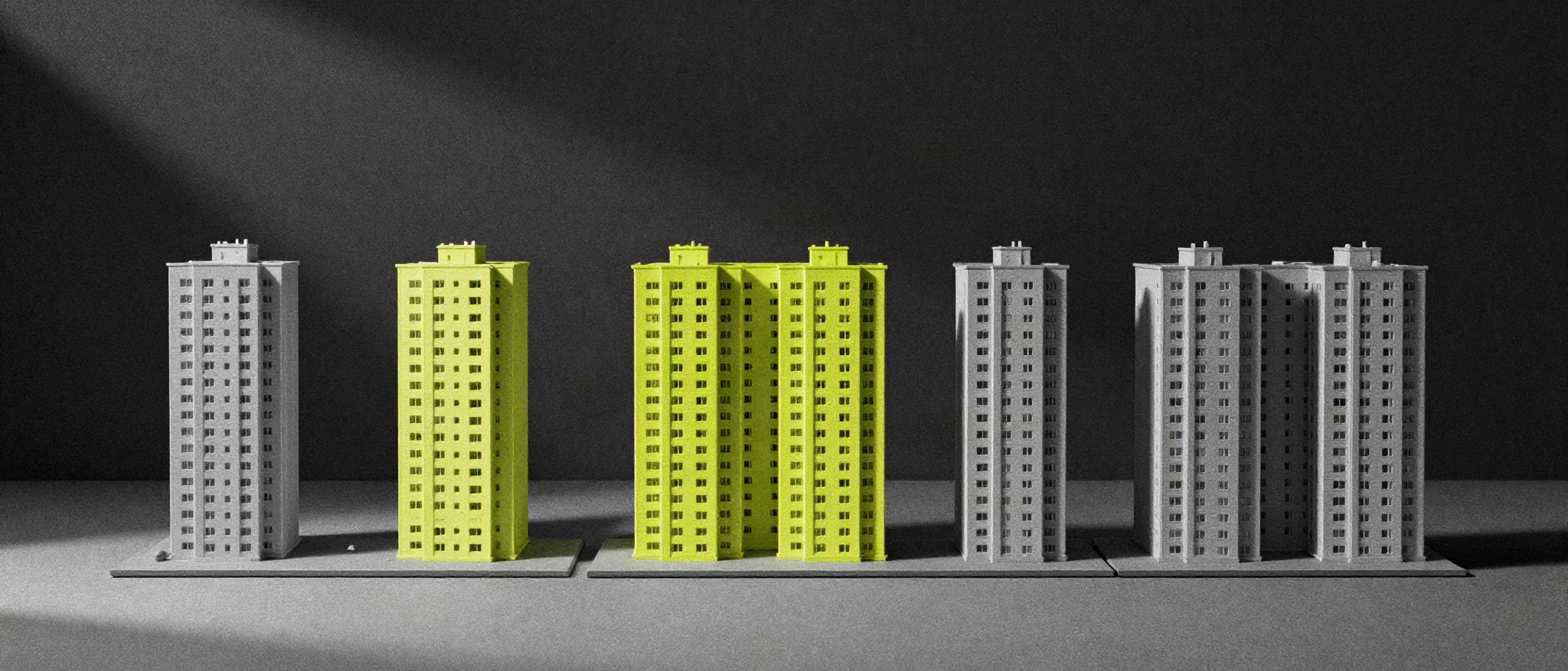
The second development starts on what the first one built.
r352 helps real estate teams turn campaign production into a repeatable operating system - from launch assets and approvals to templates, QA gates, and rollout-ready delivery.
Why does every new investment start the marketing from scratch?
Because each investment gets its own name, its own logo and its own agency, and nothing is designed to be reused. The second investment repeats the first one's work at full price. What carries over is usually only the developer's logo in the corner.
What should a developer standardise and what should stay unique?
Standardise the frame: layouts, typography, the way a floor plan and a price list are presented, the order of information in a brochure. Keep unique what genuinely differs: the name, the key visual, the neighbourhood story. Buyers do not compare grids, they compare places.
When is it worth building a template system for a developer?
From the second investment running in parallel. On one project a template is overhead. On two it starts paying for itself. The threshold is not the number of materials but the number of teams working at the same time.
How to tell this is your problem
- Each new investment launch restarts campaign production from zero
- Many assets, many stakeholders, missed deadlines
- Renders, ads, landing pages, print, and sales materials live in disconnected workflows
- Sales offices wait on materials that should be ready before launch
- Decision velocity collapses around revision rounds
Operator questions
The questions we hear from COOs and network directors in this vertical - short, specific answers, facts only.
01Every investment launch rebuilds campaign production from scratch. How do you fix that?
By building one shared production system instead of one-off campaigns. For Archicom, River Point and Bulwar Północny launched on the same system - the second launch reused templates, approval gates, and asset pipelines instead of rebuilding them. That reuse is the product: the system outlives each launch.
02Renders, ads, landing pages, print and sales materials live in separate workflows. Can they run as one?
Yes - that's what the Map phase of r3loop does. We map the launch path end-to-end (renders → ads → landing → print → sales), then standardize briefs and install QA gates so every asset type runs through one pipeline. The deliverable is a launch production workflow map your team operates after we're gone.
03How do you handle multi-stakeholder approvals without missed deadlines?
Through the Govern phase: a decision ownership model where every approval gate (Master / Variant / Pre-production) has a named owner and a defined SLA. Most revision loops aren't about quality - they happen because ownership is unclear. We also track decision velocity, so slow approvals show up as numbers, not opinions.
04What does a Diagnostic look like for a real estate developer?
5 working days, kickoff within 1-2 weeks. We map your launch production workflow, diagnose multi-stakeholder approval gates, and scan for template and toolkit opportunities. You get a one-page diagnosis with 5-7 prioritized bottlenecks plus a 30/60/90-day rollout roadmap.
05How fast can a launch system be in place before our next investment goes to market?
The Diagnostic takes 5 working days with kickoff within 1-2 weeks - so within a month you know exactly where production breaks down. A Sprint then builds one working part of the system in 4-6 weeks, fixed scope. If you have a launch date, the system is sequenced around it.