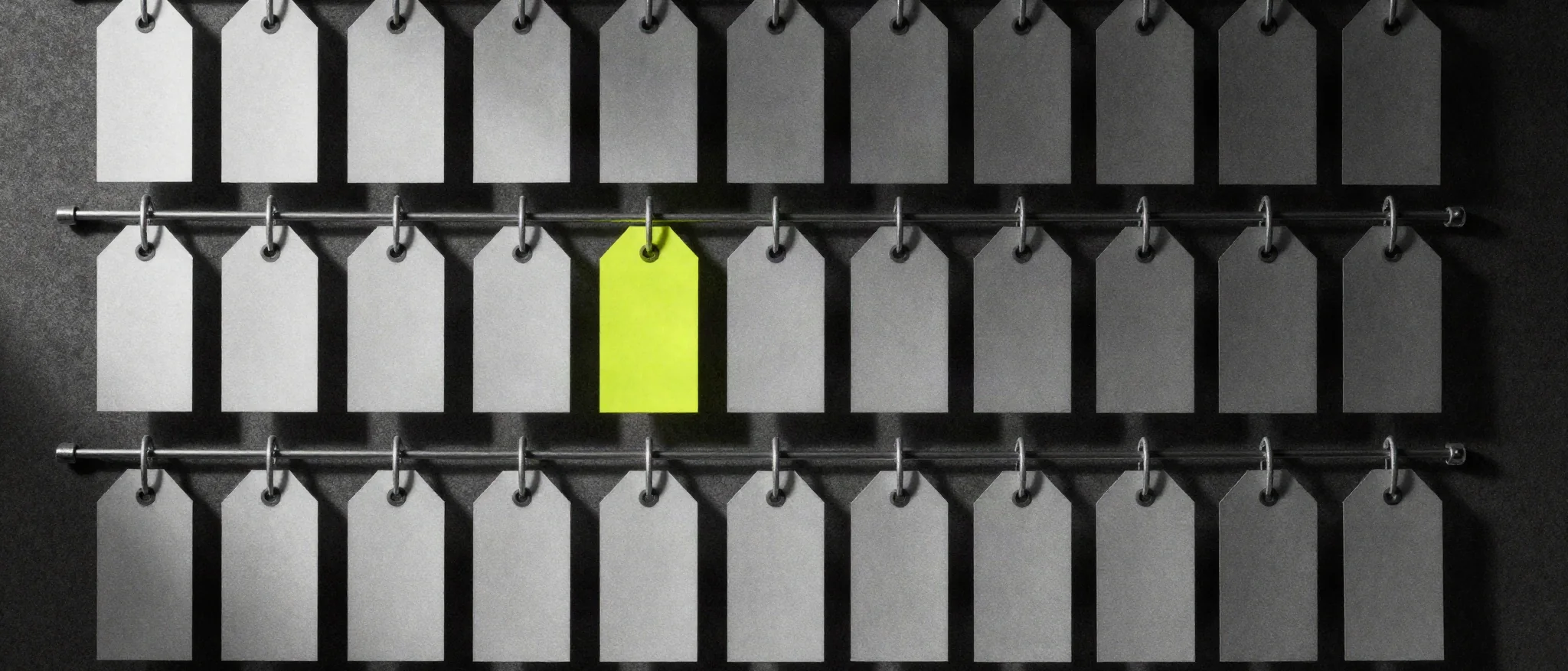
Central brand standards. Local execution speed. No leaks.
The same standard on every shelf, in every store.
r352 helps retail chains and franchise networks balance central brand governance with local execution autonomy - through templates, approval gates, and a working operating system.
Why do franchisees change central materials?
Usually because the material does not fit their reality: a different opening time, a different price, a promotion that does not run in their location. Changing it is faster than asking. The fix is not stricter rules but materials with the local fields left open by design.
How many local variants can a brand keep under control?
As many as the source allows, provided the variants are generated rather than redrawn. Hundreds of versions from one source is an operations question, not a design question. Redrawing by hand hits its ceiling at about twenty.
What does the cost of a single retail asset actually consist of?
Rarely from the design itself. It is the brief, the rounds of corrections, finding the right file, the check before print and the reprint when something was wrong. Networks that measure only the design rate are measuring the smallest part of the bill.
How to tell this is your problem
- Brand consistency leaks because each market adapts materials differently
- Local branches produce assets that don't match central standards
- Central brand team can't keep up with location-level requests
- No clear standards for local adaptation
- Brand consistency depends on individual memory, not a system
Operator questions
The questions we hear from COOs and network directors in this vertical - short, specific answers, facts only.
01How do you keep brand consistency across a franchise network without policing every location?
By replacing individual memory with a system. The Standardize and Govern phases of r3loop install reusable templates, defined local adaptation rules, and approval gates split between central and local level - each with a named owner and SLA. Consistency stops depending on who happens to remember the brand rules.
02What does a design ops audit look like for a franchise network?
The Diagnostic: 5 working days. It covers a cross-market brand consistency audit, a local adaptation rules and template framework scan, and a decision velocity baseline. The output is a one-page diagnosis with 5-7 prioritized bottlenecks and a 30/60/90-day governance roadmap.
03Our central brand team can't keep up with location-level requests. What's the fix?
Demand mapping plus standards. First we classify what's actually coming in - the target is 95%+ of requests categorized cleanly at intake. Then brief templates for standard, local, and express requests, with a readiness checklist, so 80%+ of briefs arrive production-ready. Templates and toolkits let locations self-serve the recurring asset types instead of queueing at HQ.
04How much freedom do franchisees keep under central governance?
Exactly as much as the adaptation rules define - which is the point. The system separates what's locked at master level from what each market can adapt, through Master / Variant approval gates. Central brand standards and local execution autonomy aren't opposites; the balance between them is the thing we design.
05How do you measure whether brand governance actually works?
The Measure phase of r3loop tracks decision velocity, brief throughput, consistency score, and rework rate - numbers, not opinions. A workflow dashboard goes live with the first baseline captured within 2 weeks of system launch, and the decision gate is hard: 3 measurable improvements vs baseline within 60 days, or the system isn't working.